Supreme Court Court Assistant Recruitment 2026: 15 Programmer Posts, Apply by 24 November
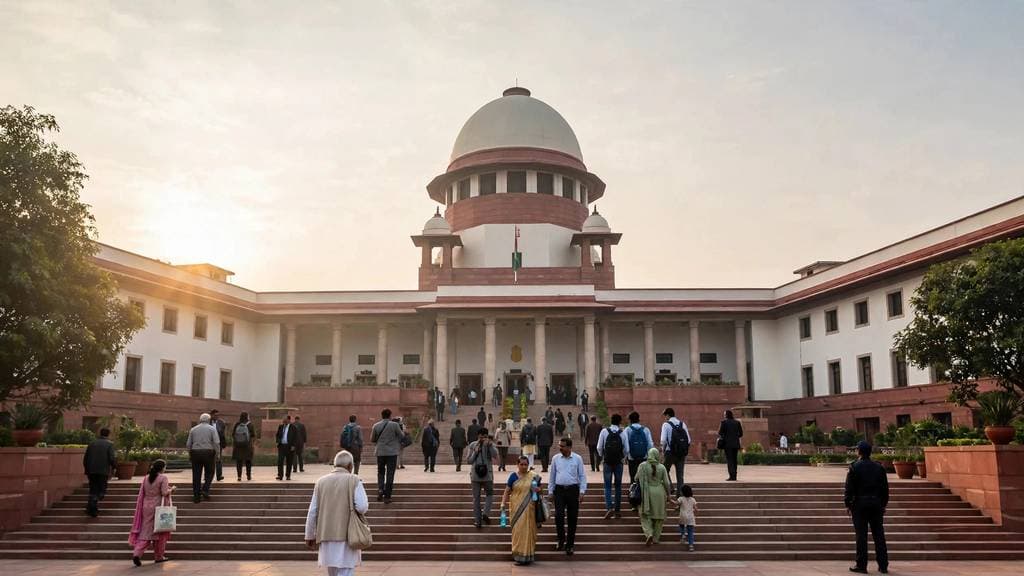
Supreme Court Court Assistant recruitment 2026 opened on 3 November 2026, when the Registry of the Supreme Court of India invited online applications for 15 tentative vacancies of Court Assistant (Technical Assistant-cum-Programmer). The post is a Group B, non-gazetted post at Level 7 of the Pay Matrix, carrying Rs. 44,900 to Rs. 1,42,400 with an initial basic pay of Rs. 44,900 plus allowances. Applications close on 24 November 2026 at 11:55 PM, and the advertisement, No. F.6/2026/Tech.Post/SC(RC), is dated 12 October 2026. Only Indian citizens can apply, and this is not a fresher post: every route demands years of software development experience.
At a glance
| Organisation | Supreme Court of India (Registry) |
|---|---|
| Post | Court Assistant (Technical Assistant-cum-Programmer), Group B, non-gazetted |
| Advertisement number | F.6/2026/Tech.Post/SC(RC), dated 12 October 2026 |
| Total vacancies | 15 (tentative) |
| Pay | Level 7, Rs. 44,900 to Rs. 1,42,400, initial basic pay Rs. 44,900 plus allowances |
| Application window | 3 November 2026 to 24 November 2026, 11:55 PM |
| Application mode | Online only, through sci.gov.in |
| Application fee | Rs. 1,500 for General and Unreserved; Rs. 750 for SC, ST, OBC (Non-Creamy Layer), ex-servicemen and physically challenged candidates, plus bank charges |
| Objective tests | Tentatively 22 December 2026 |
| Test centres | Delhi/NCR, Mumbai, Kolkata, Hyderabad and Bengaluru |
Supreme Court Court Assistant vacancies: 15 tentative posts for a panel
The 15 posts are tentative and may change because of administrative needs, and the recruitment is held to prepare a panel. The advertisement gives no category-wise split; reservation follows Rule 4A of the Supreme Court Officers and Servants (Conditions of Service and Conduct) Rules, 1961. Applicants should therefore not rely on a category-wise figure read elsewhere, and should check the Registry's own updates for any change to the vacancy count.
This post should not be confused with other Supreme Court recruitment running in parallel. The Court Assistant (Technical Assistant-cum-Programmer) post is a technical programming post with an experience requirement, and it is distinct from non-technical court posts advertised separately. Applying for the wrong post, or assuming the eligibility of one post applies to another, is an easy mistake to make when several Registry advertisements are open at once.
Supreme Court Court Assistant eligibility: a computer degree plus software experience
Qualifications and age are counted as on 1 October 2026, and only Indian citizens can apply. Candidates must meet one of three routes. The first route is a B.E. or B.Tech. in Computer Science or Information Technology from a recognised university, plus 3 years of experience in software development. The second route is a Master's degree in Computer Application or M.Sc. in Computer Science, plus 3 years of software development experience. The third route is a B.Sc. in Computer Science or a Bachelor in Computer Application with first class or at least 60 per cent aggregate, plus 4 years of software development experience. All degrees must be from a recognised university or equivalent, the experience must be in software development, and experience certificates are uploaded with the form and checked again at document verification. A law degree is preferred and counts as an additional qualification, but it is not compulsory.
The age limit is 18 to 35 years as on 1 October 2026, with usual relaxation as per Government of India rules for SC, ST, OBC (Non-Creamy Layer), physically challenged and ex-servicemen candidates; the advertisement does not state the relaxation years. Dependants of freedom fighters receive up to 5 years over the limit, and departmental candidates of the Registry face no upper age limit. Staff of other government departments, public sector undertakings and nationalised banks receive no age relaxation and must submit a No Objection Certificate from their employer at document verification. Counting experience years carefully against the cut-off date of 1 October 2026 is essential, since a shortfall discovered at verification ends the candidature.
Supreme Court Court Assistant selection: two objective tests, a practical test and an interview
Selection has four stages. The Objective Type Test runs for 1.5 hours, carries 100 marks and needs a minimum of 50 marks to qualify. The Objective Type Technical Aptitude Test also runs for 1.5 hours, carries 50 marks and needs a minimum of 25 marks. The Practical Aptitude Test runs for 1.5 hours, carries 50 marks and needs a minimum of 25 marks. The interview carries 25 marks and needs a minimum of 13 marks. Both objective tests carry negative marking of 0.25 marks per wrong answer, so leaving a question blank when truly unsure is wiser than guessing.
The first test contains 100 questions: 40 on General English including comprehension, 30 on General Aptitude and 30 on Reasoning and Quantitative Aptitude. If many candidates qualify by scoring at least 50 per cent in each objective test, the top candidates in a 1:10 ratio against the tentative vacancies are shortlisted for the Practical Aptitude Test, and candidates who qualify all three tests are called for interview in a 1:3 ratio. The two objective tests are tentatively scheduled for 22 December 2026 in Delhi/NCR, Mumbai, Kolkata, Hyderabad and Bengaluru, with cities chosen in order of preference; the Practical Aptitude Test is held in Delhi/NCR, and the interview is held online or in Delhi, as decided. Answer keys are due to be uploaded on 24 December 2026, with an objection window from 24 December 2026 to 25 December 2026 at 11:55 PM, at Rs. 100 per objection, refunded if the objection is found valid. Admission at every stage is purely provisional until documents are verified, and the Registry reserves the right to change the selection process without notice.

How to apply for the Supreme Court Court Assistant posts
First, from 3 November 2026, open the recruitment link on the Supreme Court website, sci.gov.in. Second, fill in the online application form with details exactly as on the Class X certificate, and give the undertaking that the advertisement has been read and will be followed. Third, upload the photograph, signature, Class X, Class XII, graduation and experience certificates, plus caste or disability certificate if applicable. Fourth, pay the fee online through the UCO Bank payment gateway; the fee is non-refundable, bank charges are extra, and no postal application is accepted. Fifth, preview, submit and keep the application number for the admit card, which is downloaded from the website and not sent by post.
Three conditions deserve emphasis. If more than one form is submitted, only the last one is considered, and a submitted form cannot be withdrawn or modified, with no change of category allowed. Printouts need not be sent to the Registry. And a personal email address and mobile number that stay active must be used, because test dates and updates are sent by SMS and email. No travelling allowance is paid for tests or interview, and a change of centre or date is not entertained. For readers in Nepal, the citizenship limit is the first fact to settle: the advertisement states that only Indian citizens can apply, so readers outside India should not assume eligibility. No agent can secure a Registry post, and applications go only through sci.gov.in. Growentix also covers other Indian government recruitment, including APPSC Assistant Executive Engineer recruitment for 503 posts and BEL Probationary Engineer recruitment for 350 posts.
Sources: Supreme Court of India, sci.gov.in, and the GovtJobsAlert report on Advertisement No. F.6/2026/Tech.Post/SC(RC).
Sources: sci.gov.in · govtjobsalert.in