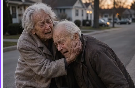
The door behind them had already closed.
For a few seconds, the elderly couple stood frozen on the porch, as if their hearts had not yet understood what had just happened. The house was still there. The windows were still glowing with warm light. The same walls still held memories of family dinners, birthdays, laughter, and years of sacrifice. But now, that house no longer belonged to them.
To the world, it was just a quiet American suburban home.
To them, it was the place where their love had been thrown away.
The old wife, nearly ninety years old, held her handbag tightly against her chest. Her thin white hair moved slightly in the cold evening wind. Her hands trembled so badly that the bag shook with them. Tears had already made her cheeks wet, but she did not wipe them away. She kept staring at the closed door, waiting for it to open again.
Maybe her son would come back.
Maybe he would say he was sorry.
Maybe he would remember that she was his mother.
But the door stayed shut.
Beside her, her husband stood bent and silent, leaning heavily on his cane. At ninety-five, every step was already a battle for him. His back was curved from age, his knees weak, and his fingers thin and shaking around the wooden handle of the cane. His eyes were red. His breathing was heavy. But he tried to stand strong because his wife was watching him.
He looked at the door one last time and swallowed his pain.
“Come,” he whispered, his voice weak. “We should go.”
The old woman turned to him with fear in her eyes. “Where?” she asked softly.
He had no answer.
That silence was more painful than any word.
Slowly, they stepped down from the porch. The husband moved first, placing his cane carefully on each step. His wife followed beside him, holding his arm with one hand while clutching her handbag with the other. Their small suitcase dragged behind them, its wheels bumping unevenly against the concrete. A folded blanket hung halfway out of it, touching the ground like a symbol of their humiliation.
They had not packed properly. They had not been given time. Their lives had been thrown into one little suitcase and pushed out into the cold.
The sidewalk stretched ahead of them, quiet and gray. Parked cars lined the street. Leafless trees stood like silent witnesses. The houses around them looked peaceful, but no one came outside. No one asked why two elderly people were walking away from a house with tears on their faces.
The old husband tried to keep walking.
One step.
Then another.
His cane tapped against the sidewalk.
Tap.
Tap.
Tap.
Each sound felt heavier than the last.
His wife looked at him again and again. She could see his breathing getting worse. His shoulders were shaking. His hand was losing strength around the cane. His feet moved slowly, but his body looked like it could give up at any moment.
“Please,” she whispered, holding his arm tighter. “Walk slowly. Don’t push yourself.”
He tried to smile, but his lips only trembled.
“I’m fine,” he lied.
She knew he was not fine.
They had survived many hard years together. They had faced unpaid bills, sickness, grief, loneliness, and old age. But this pain was different. This pain came from their own child. It was not hunger, not poverty, not illness. It was betrayal.
And betrayal makes even breathing feel difficult.
After a few more steps, the husband suddenly stopped.
His cane shook.
His knees bent.
His face turned pale.
The wife saw it immediately.
“No,” she cried, panic rising in her weak voice. “Please… please hold on.”
He tried to take another step, but his body refused. His grip loosened from the cane. The cane fell from his hand and hit the sidewalk with a sharp wooden sound.
Then his knees gave out.
He dropped down hard onto one knee near the curb, one hand clutching his chest, the other trying to catch himself. The suitcase tipped over behind them. The blanket slipped out and spread across the cold sidewalk. The handbag fell from the wife’s arm.
For a moment, the old man could not speak.
He only breathed.
Heavy.
Broken.
Painful.
The wife dropped beside him as quickly as her fragile body allowed. Her knees hurt when they touched the ground, but she did not care. She held his shoulders with both trembling hands.
“Please,” she cried. “Please don’t fall. Please stay with me.”
The husband looked at her with tired, watery eyes. His face was filled with shame, as if he had failed her. As if being old and weak was his fault. As if he should still be strong enough to protect her from the cruelty of the world.
“I can’t…” he whispered. “I can’t do this anymore.”
Those words broke her completely.
“No, no,” she sobbed, touching his face. “Don’t say that. Please don’t say that.”
Her fingers moved gently over his wrinkled cheek. They were the same fingers that had held his hand when they were young. The same hands that had cooked for their family, folded clothes, wiped tears, and prayed through long nights. Now those hands shook helplessly on a cold sidewalk, trying to hold together the last person she had left.
A car passed slowly in the distance.
For one small second, she lifted her head with hope.
“Help!” she cried weakly. “Somebody please help us! Please!”
The car continued down the street.
It did not stop.
The old woman’s voice faded into the cold air. The neighborhood remained quiet. Somewhere far away, a dog barked. A porch light flickered on at another house. But no one came.
The husband lowered his eyes.
“You shouldn’t be out here because of me,” he whispered.
She turned back to him quickly, crying harder. “No. Don’t say that. You’re all I have.”
Her voice cracked on the last word.
All I have.
That was the truth. Their son had shut the door. Their family had turned away. Their home had rejected them. But they still had each other. Even broken, even homeless, even weak, they were still husband and wife.
She reached for the fallen blanket and pulled it toward him with trembling hands. It was dusty from the sidewalk, but she placed it gently over his shoulders. He tried to stop her, but he did not have the strength.
“You’ll get cold,” he said.
She shook her head. “I don’t care.”
Then she held his face again, looking into his tired eyes.
“Please don’t leave me here alone,” she whispered.
He stared at her, and tears finally rolled down his cheeks. For all his life, he had tried to be a strong man. He had worked, protected, carried burdens, hidden his pain, and stood like a wall for his family. But now, on that sidewalk, he was just an old man with a broken heart.
“I’m sorry,” he said. “I couldn’t protect you.”
The wife leaned her forehead close to his.
“You did,” she cried. “You protected me my whole life.”
The suitcase lay open beside them. A sweater hung out, half on the pavement. The cane rested out of reach. The handbag was tipped over near the curb. Everything around them looked scattered, just like their lives.
The fading evening light turned blue-gray. The cold grew sharper. Their bodies looked small against the long empty street. Houses stood around them, but none felt like shelter. Windows glowed warmly, but none belonged to them.
The husband tried to sit up straighter, but pain crossed his face. The wife held him carefully, one hand on his chest, the other on his cheek.
“Breathe slowly,” she said through tears. “Just breathe with me.”
He looked at her.
Even after everything, she was still trying to save him.
That was love.
Not the kind shown in bright photographs or wedding songs, but the kind that stays when everything else is gone. The kind that kneels on cold concrete. The kind that covers shaking shoulders with a dirty blanket. The kind that cries for help even when the world refuses to listen.
The old woman looked up again, her eyes full of desperation.
“Please,” she whispered to the empty street, to the darkening sky, to anyone who might still have a heart. “Somebody help us.”
But only silence answered.
The husband sat slumped on the sidewalk, barely able to hold himself up. His wife knelt beside him, crying, her fragile hand resting on his chest as if she were afraid his heart might stop beneath her palm. The cane, suitcase, blanket, and handbag lay scattered around them like the remains of a life that had been pushed out without mercy.
Behind them, the house stood silent.
In front of them, the road stretched into darkness.
And between those two places sat two elderly souls who had lost almost everything — except each other.
That night, the street became colder.
The world became quieter.
And two old hearts learned that sometimes the only home left is the hand still holding yours.