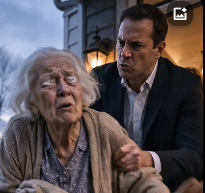
The cold evening light settled over the quiet suburban street like a gray blanket.
Inside the large modern house, warm yellow lights glowed through tall windows. The kitchen was clean and bright. The living room had expensive furniture, a white fireplace, and family portraits hanging neatly on the wall. From the outside, it looked like a perfect American home.
But on the front porch, an old blind woman was being pushed out like a stranger.
Her name was Margaret.
She was eighty-eight years old, small, fragile, and bent from a lifetime of pain. Thin white hair framed her wrinkled face. Her cloudy eyes stared into nothing. Her hands trembled as she held a worn blanket against her chest. In one hand, she gripped a wooden walking stick, tapping helplessly at the porch floor, trying to understand where she was being taken.
“Daniel…” she whispered. “Son… please slow down. I can’t see.”
Her son did not slow down.
Daniel was forty-five, tall, wealthy, and sharply dressed. He wore an expensive watch and a dark coat. His jaw was tight with anger, but beneath that anger was something uglier — shame. He was ashamed of his blind mother. Ashamed of her old cardigan. Ashamed of her trembling hands. Ashamed when guests came over and she called his name too loudly from the hallway.
To him, she had become a problem.
His wife, Vanessa, stood near the open door in a stylish cream sweater, her arms crossed, her face cold.
“We are done, Margaret,” Vanessa said sharply. “We have tried. We have been patient. But this is our home, and we are not living like this anymore.”
Margaret turned her cloudy eyes toward the sound of Vanessa’s voice.
“I don’t want trouble,” the old woman said softly. “I can stay in the small room. I won’t bother anyone.”
Vanessa laughed under her breath.
“You embarrass us. Do you understand that? Daniel has important friends. Business partners. Neighbors. We can’t keep explaining why his blind mother is wandering around the house like some helpless burden.”
Daniel looked away, but he did not defend her.
Margaret’s lips trembled.
“I raised you in a house much smaller than this,” she said. “I never thought I was a burden then.”
Daniel’s face hardened.
“Don’t start with that again,” he snapped. “Every time, it is the same story. You raised me. You sacrificed. You suffered. I know, Mom. I know.”
But he did not know.
Not really.
He grabbed her arm again and pulled her closer to the steps.
Margaret panicked. Her walking stick slipped from her shaking fingers and struck the porch with a hollow sound. She reached blindly into the air.
“My cane,” she cried. “Daniel, my cane fell. Please. I can’t walk without it.”
He did not pick it up.
Vanessa stepped forward and kicked the cane aside with the tip of her expensive boot.
“Take your blanket and your bag,” she said. “That’s all you need.”
Margaret’s old cloth bag hung loosely from her shoulder. It was faded and torn near the zipper. Inside were a few medicines, a sweater, a handkerchief, and old papers she had kept for years. She clutched it with one hand and reached for Daniel with the other.
“Son,” she begged, her broken voice shaking in the cold. “Please don’t leave me outside. I can’t see. I don’t know where to go.”
Daniel pulled his hand away as if her touch burned him.
“You should have thought about that before making my life impossible,” he said. “I have a family. I have responsibilities. I can’t spend every day taking care of you.”
Margaret stood still.
The words landed quietly, but they broke something inside her.
Every day taking care of you.
She remembered a different time.
A tiny apartment with leaking windows.
A little boy coughing through winter nights.
A mother staying awake beside his bed, pressing a damp cloth to his forehead.
A child crying because he could not see clearly after the accident.
Doctors speaking in low voices.
Bills piling on the kitchen table.
Her own meals skipped so he could eat.
Her own coat sold so he could have medicine.
She remembered carrying him through hospital hallways when he was too weak to walk. She remembered his small hand holding her finger. She remembered him asking, “Mama, will I see again?”
And she remembered telling him, “Yes, baby. You will see everything.”
Daniel had been only seven years old then. A sharp piece of glass from a schoolyard accident had damaged his eye badly. Infection spread quickly. The doctors had warned that his future vision was in danger. There was a surgery, rare and risky, and decisions had to be made fast.
Margaret had signed the papers alone.
His father was already gone. Some said he left. Some said he died from a sickness that took him too early. Either way, Daniel had only one parent standing beside him in that hospital.
And Margaret had given everything.
Even the light from her own world.
But Daniel had been too young to understand. Later, when he asked why her eyes had grown weak, she only smiled and said, “Old age comes early for some of us.”
She never wanted him to live with guilt.
She wanted him to live with vision.
Now that same son stood in front of her, throwing her into the cold.
“Daniel,” she whispered, “I never asked you for much.”
Vanessa rolled her eyes.
“You ask for everything. Help walking. Help eating. Help finding your pills. Help getting to the bathroom. We are not nurses.”
Margaret lowered her head.
“I’m sorry,” she said.
That made Daniel angrier for reasons he did not understand.
“Stop saying sorry like that,” he shouted. “Stop making me feel guilty.”
The old woman flinched.
From inside the house, Daniel’s teenage daughter watched from the staircase, frightened and silent. She had never seen her father this cruel before. She looked at her grandmother’s shaking hands and wanted to cry, but Vanessa turned and snapped, “Go upstairs.”
The girl disappeared.
Margaret bent slowly, trying to feel around for her fallen cane. Her old bag slipped from her shoulder and dropped onto the porch. The zipper opened. Medicine bottles rolled out. A handkerchief fell. Then a yellowed hospital envelope slid across the wood and stopped near Daniel’s shoe.
A faded photograph slipped out with it.
Daniel glanced down.
At first, he only saw an old picture.
A little boy in a hospital bed.
One eye covered with bandages.
Beside him sat a young woman with tired eyes and a brave smile.
His mother.
Daniel stared.
Something about the photo reached into a locked room inside his memory.
He bent down slowly and picked it up.
Vanessa frowned. “Daniel, leave it. Just get her out.”
But Daniel was already opening the envelope.
Inside was an old medical document, folded carefully. The paper was worn from years of being kept, opened, and hidden again. At the top was the name of a hospital. Below it were signatures, surgical notes, and words he did not fully understand at first.
Then he saw his name.
Daniel Harris. Age seven.
Then he saw hers.
Margaret Harris. Donor consent.
His breath stopped.
He read further, his hands shaking.
The words blurred, but their meaning struck him like a blow.
His mother had not simply gone blind from old age.
She had sacrificed her sight so he could keep his.
Daniel’s mouth opened, but no sound came out.
The porch, the cold air, Vanessa’s voice, the neighborhood — everything faded.
He was seven again.
He remembered waking in a hospital room. He remembered his mother’s hand holding his. He remembered asking why she wore dark glasses after the surgery. He remembered her laughing softly and saying, “Don’t worry about me. I can still hear your voice.”
He remembered growing up, running across baseball fields, reading books, driving cars, seeing sunsets, seeing his own wife walk down the aisle, seeing his daughter’s face when she was born.
He had seen the world because his mother had given up hers.
And now he had pushed her out into the dark.
“Mom…” Daniel whispered.
Margaret turned her face toward his voice.
She could not see the paper in his hands. She could not see the shock on his face. She could not see his pride collapsing.
But she heard something change in him.
Daniel’s knees weakened. He looked at the old woman in the beige cardigan, standing barefoot in grief on his porch, and for the first time in years, he truly saw her.
Not as a burden.
Not as an embarrassment.
Not as an old blind woman in his hallway.
He saw the young mother who had carried him through pain. The woman who had chosen darkness so her little boy could live in light.
His eyes filled with tears.
“Why didn’t you tell me?” he asked, his voice breaking.
Margaret held the blanket tighter.
“You were a child,” she said softly. “You needed to heal.”
“You gave me your sight,” he cried. “You gave me everything.”
She smiled faintly, but it was not a happy smile. It was the tired smile of a mother who had been hurt too deeply but still loved too much.
“You were my son,” she said. “What else could I give?”
Daniel began to sob.
The sound shocked Vanessa. She stepped back, suddenly uncomfortable, as if the truth had made the whole porch too small for her cruelty.
Daniel dropped the papers and rushed toward his mother.
“Mom, I’m sorry,” he cried. “Please forgive me. Please. I didn’t know.”
He reached for her hands, but they were cold and shaking.
Margaret did not pull away.
She simply stood there, blind eyes turned toward his voice.
“I never wanted your money,” she whispered.
Daniel cried harder.
“I never wanted your house,” she continued. “I only wanted to hear your voice.”
Those words destroyed him.
Because he finally understood.
She had not been asking for comfort.
She had been asking for kindness.
She had not wanted luxury.
She had wanted her son.
The cold wind moved across the porch. The hospital paper lay open near the fallen cane. The faded photograph rested beside it — a little boy smiling beside the mother who gave him the world.
Daniel lowered himself to his knees in front of her.
“Please come inside,” he begged. “Please, Mom. Come home.”
But Margaret’s body had grown weak from the cold and the shock. She slowly sank down onto the porch step, trembling beneath her old blanket. Daniel tried to hold her, but she only placed one wrinkled hand on his head.
The same way she had when he was a boy.
“I can’t see your face anymore,” she said softly. “But I still know when you’re crying.”
Daniel buried his face in her lap.
Behind them, the rich house glowed warmly.
But it no longer looked beautiful.
It looked empty.
Because a home without gratitude is only walls. A family without compassion is only blood. And a son who forgets his mother’s sacrifice may one day open his eyes and realize he has been blind all along.