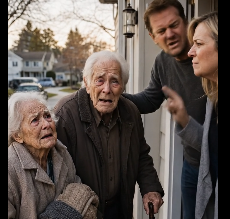
The evening was cold in a quiet American neighborhood.
The sky had already turned gray, and the winter wind moved slowly through the dry trees standing beside the suburban houses. Every home on the street looked peaceful from the outside. Warm lights glowed behind glass windows. Cars were parked neatly in driveways. Families were probably sitting inside, eating dinner, laughing, watching television, or talking about their day.
But in front of one house, a tragedy was unfolding.
On the porch stood an elderly couple who had spent almost their entire lives loving, sacrificing, and surviving together. The wife was nearly ninety years old. Her body was fragile, her shoulders weak, and her wrinkled hands trembled as she clutched an old handbag against her chest. Her eyes were red from crying. Tears ran down her cheeks and disappeared into the deep lines on her face. She looked confused, terrified, and humiliated, as if the world she had trusted had suddenly disappeared beneath her feet.
Beside her stood her husband, a ninety-five-year-old man whose back was bent from age and years of hard work. He leaned heavily on a wooden cane, but even the cane seemed barely enough to hold him upright. His breathing was slow and broken. His thin lips trembled. His eyes were full of tears, but he tried to keep himself strong for his wife. Even in that moment, when his own heart was breaking, he was watching her with worry.
A small suitcase sat near their feet. A folded blanket, a worn purse, and a few belongings were scattered around them. These were not just things. They were the last pieces of dignity they had left.
Inside the doorway stood their own son.
The same son the old mother had carried in her arms when he was a baby. The same son the father had worked double shifts for, so he could have food, clothes, school, and a better future. The same son whose fever they had watched through sleepless nights. The same son for whom they had sacrificed comfort, dreams, and youth.
Now that son stood in front of them with anger in his eyes.
His wife stood beside him, her arms crossed, her face cold and impatient. There was no pity in her expression. No softness. No shame. She looked at the elderly couple as if they were a burden, as if their weakness was an insult, as if their presence in the house had become unbearable.
The son pointed toward the street and shouted, “I told you already! Get out of this house! You are not staying here anymore!”
The mother flinched at his voice. Her body shook harder. She opened her mouth to speak, but the words came out broken and breathless.
“Please…” she whispered, her voice trembling. “Please don’t throw us out. We have nowhere to go.”
Her eyes searched her son’s face, hoping to find even one small memory of love. Maybe he would remember the woman who fed him when she herself stayed hungry. Maybe he would remember the father who walked miles to work just to pay the bills. Maybe he would remember that before he became a man with a house and a voice, he was once a helpless child in their arms.
But he remembered nothing.
The daughter-in-law stepped forward and snapped, “Stop pretending to be helpless. Take your things and leave. We are done with you.”
The old father lifted one shaking hand toward his son. He did not raise it in anger. He raised it like a father begging his own child not to destroy him.
“Son…” he said softly, his voice cracking. “Please. Your mother is sick. We are too old for this. Please don’t do this.”
For one second, the street became silent. The old man’s words seemed to hang in the cold air. A father was not asking for money. He was not asking for luxury. He was only asking not to be thrown away like something useless.
But the son’s face hardened.
He stepped forward suddenly and knocked his father’s trembling hand away.
“Don’t call me that!” he yelled. “I’m sick of this! You’ve ruined enough already!”
The old man stumbled backward. His cane slipped on the porch. His knees bent, and for a terrible moment it looked like he might fall. The mother cried out and reached toward him.
“No! Please don’t hurt him!”
But before she could move, the daughter-in-law grabbed her arm roughly and pulled her back. The old woman gasped in pain.
“Please… my arm…” she cried. “Don’t push me. Please.”
The daughter-in-law looked at her with disgust and said, “You cry every day and expect sympathy. We’re tired of you. You’re old, useless, and this house is not yours anymore.”
Those words hit harder than the cold wind. The mother’s face collapsed into helpless grief. She was not just being pushed out of a house. She was being erased from the family she had built with love.
The son shoved the father again, this time harder. The old man lost balance. His cane fell from his hand and struck the porch with a loud wooden clatter. The sound was small, but it felt like something inside him had broken. His suitcase tipped over, sliding across the ground. A sweater slipped out. The folded blanket fell open and dragged against the porch floor.
The father gasped, trying to breathe. His fingers reached down toward the fallen cane, but his hands shook too badly.
“I worked my whole life for this family…” he whispered.
No one answered him.
The son kicked the blanket toward the steps and shouted, “Take your junk and leave! You’re not my responsibility anymore!”
The mother looked at her son as if she had been stabbed by invisible hands. She remembered holding him when he cried as a child. She remembered teaching him to walk. She remembered saving every dollar so he could have birthday gifts. She remembered standing at the window years ago, waiting for him to come home from school. Back then, one small scratch on his hand would make her panic.
Now he watched his old father nearly fall and felt nothing.
The daughter-in-law pushed the suitcase farther away with her foot. “Go beg someone else to take care of you,” she said coldly. “We don’t care where you go.”
The old mother slowly bent down near the fallen belongings. Her knees were weak, and her hands trembled as she tried to gather the sweater and blanket. Tears dropped onto the cloth. She kept looking back at the doorway, still hoping this nightmare would end. Maybe her son would suddenly feel ashamed. Maybe he would run forward, lift his father’s cane, and say, “I’m sorry.” Maybe he would bring them back inside and wrap his arms around them.
But he did not.
The father finally managed to pick up his cane. He stood beside his wife, hunched and shaking, his face wet with tears. He looked at the house one last time. It was the same house where family photos once hung on the wall. The same house where his wife had cooked meals. The same house where grandchildren had once laughed. The same house where he believed he would spend his final years in peace.
Now it looked like a stranger’s house.
The son stood in the doorway, breathing angrily. The daughter-in-law crossed her arms and looked away. Then, slowly, the door began to close.
The old mother’s eyes widened.
That door was not just wood and metal. It was the last symbol of family. It was the boundary between belonging and abandonment. As it closed, it shut out years of sacrifice, years of love, years of memories, and every hope the parents had left.
The click of the lock was soft.
But to the elderly couple, it sounded like the end of the world.
They stood outside in the cold evening, alone on the porch with a suitcase, a blanket, and broken hearts. The mother cried quietly beside the fallen bag. The father held his cane with both hands, his body shaking, trying to stay strong even when there was nothing left to hold onto.
Across the street, the neighborhood remained silent. Lights glowed in other homes. Life continued for everyone else.
But for them, everything had stopped.
Because the deepest pain does not always come from strangers. Sometimes it comes from the child you loved the most. Sometimes the cruelest wound is not made by enemies, but by the family you gave your whole life to protect.
And on that cold evening, two old hearts learned the hardest truth of all:
A house can have walls, windows, and a roof.
But without love, it is no longer a home.