Rain was falling softly on the city that afternoon.
Not heavy rain. Not the kind that makes people stop and stare at the sky. It was the quiet kind of rain that makes the streets shine, makes cars splash through puddles, and makes people pull their coats tighter around themselves.
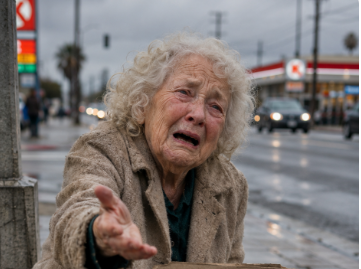
On the edge of a wet sidewalk, beside a busy road in a small American city, sat a very old woman.
Her name was Eleanor Miller.
She was ninety years old.
Her curly white hair was damp from the rain. Her beige coat was old, thin, and soaked at the shoulders. Her hands were small and wrinkled, trembling from cold and hunger. Her eyes were tired and watery, not only from age, but from a sadness too deep for words.
Beside her sat an old brown handbag.
It was the only thing she had left.
In her shaking hands, Eleanor held a piece of cardboard. The words on it were written unevenly with a black marker.
I AM HUNGRY. PLEASE HELP.
Cars passed by.
People walked past.
Shoes stepped around her.
Some people looked at the sign but not at her face. Some looked at her face and quickly looked away. A young man with headphones walked by pretending he did not hear her. A woman pulled her little child closer and crossed to the other side of the sidewalk. A man in a clean black coat dropped a coin near Eleanor’s feet without stopping.
The coin rolled near her handbag.
Eleanor looked down slowly.
“Thank you,” she whispered.
But the man was already gone.
She lifted one trembling hand toward the strangers passing by.
“Please…” she said softly. “I’m hungry… can you spare something to eat?”
Her voice was gentle. Weak. Almost lost under the sound of rain and traffic.
No one answered.
Eleanor did not shout. She did not complain. She did not curse the world. She simply sat there with her wet coat, her empty stomach, and her broken heart.
To most people, she looked like just another homeless old woman.
But Eleanor had once been much more than that.
She had once been a wife.
A mother.
A grandmother.
A woman with a warm kitchen, clean curtains, family photographs, and Sunday dinners.
Years ago, Eleanor lived in a small house with a blue front door. It was not a rich house, but it was full of life. Her husband, Walter, worked hard every day. He came home tired, with dust on his boots and pain in his back, but he always smiled when he saw her.
Every Sunday, Eleanor cooked soup in a big silver pot. The smell filled the house before noon. Her son would come in from the yard with dirty hands after fixing the fence. Her daughter would laugh in the kitchen while setting plates on the table. Walter would sit near the window, watching Eleanor move around the room like she was the heart of the whole home.
“Ellie,” Walter used to say, “as long as I’m here, you’ll never be alone.”
And she believed him.
She believed love could protect a family.
She believed ordinary days would last forever.
She believed there would always be another Sunday dinner.
But life can change in one night.
It happened after midnight.
The earth began to shake.
At first, Eleanor thought it was thunder. Then the walls groaned. The dishes rattled. A picture frame fell from the wall and broke on the floor. Walter woke up and reached for her hand.
“Eleanor!” he shouted.
Before she could answer, the whole house moved like it was being torn from the ground.
Glass shattered.
Wood cracked.
The lights went out.
The kitchen where she had cooked for her children shook violently. The bedroom she had shared with Walter for decades filled with dust. Somewhere in the darkness, her daughter screamed. Her son called her name.
Then came a terrible crash.
And after that, silence.
Not peaceful silence.
A heavy, frightening silence.
Eleanor opened her eyes under broken wood and dust. Her body hurt. Her mouth was dry. She could not move her legs well. Everything around her was dark.
“Walter?” she whispered.
No answer.
“My baby?” she called, her voice shaking. “Where are you?”
No answer.
She called her son’s name.
She called her daughter’s name.
She called for Walter again and again until her throat burned.
But only dust answered her.
Hours later, rescuers pulled Eleanor from the broken house. She was alive, but everything she loved was gone.
Walter was gone.
Her son was gone.
Her daughter was gone.
The blue front door was buried under broken walls. The kitchen was destroyed. The family photographs were lost in the rubble. The Sunday table where they once laughed together no longer existed.
People told Eleanor she was lucky to survive.
But Eleanor did not feel lucky.
She felt left behind.
After the earthquake, everything became harder. Papers were lost. Insurance was delayed. Medical bills came. Shelters were full. Some places were too crowded, some too unsafe, and Eleanor was too old and weak to fight through the system alone.
One by one, doors closed.
No close family came.
No one had room.
No one had time.
And slowly, the woman who once fed everyone ended up hungry on a sidewalk, holding a cardboard sign in the rain.
That afternoon, Eleanor’s stomach hurt from emptiness. Her knees ached from sitting on the cold concrete. Her fingers were stiff around the cardboard.
Still, whenever someone passed, she tried.
“Please…” she whispered. “Anything helps.”
Most people kept walking.
Then, a little girl stopped.
She was maybe seven years old, wearing a red raincoat and holding her father’s hand. She looked at Eleanor’s sign, then at Eleanor’s face.
“Daddy,” the little girl whispered, “she’s hungry.”
Her father slowed down.
He was a tired-looking man in work boots and a dark jacket. Maybe he had his own problems. Maybe he did not have much money either. But he looked at Eleanor the way no one else had that day.
Not like she was trash.
Not like she was invisible.
Like she was someone’s mother.
He knelt down slightly, careful not to scare her.
“Ma’am,” he said gently, “when was the last time you ate?”
Eleanor tried to smile.
The smile was small and painful.
“I don’t remember, sweetheart,” she said.
The little girl’s eyes filled with tears.
The father looked down for a moment, then looked toward the small diner across the street.
“Stay here,” he said softly. “We’ll be right back.”
Eleanor nodded, but she did not expect them to return.
People often said things.
People often forgot.
She looked down at the rain hitting the sidewalk and pulled her coat closer.
A few minutes later, the little girl came running back carefully, holding a paper bag. Her father followed with a cup of hot coffee, a bowl of soup in a takeout container, and a folded blanket.
Eleanor stared at them.
Her lips began to tremble.
The father sat beside her on the edge of the sidewalk, even though the ground was wet.
“This is for you,” he said. “It’s warm.”
The little girl placed the blanket gently around Eleanor’s shoulders.
Eleanor touched the soft fabric with shaking fingers. Then she looked at the soup.
For a moment, she could not eat.
She just held it.
The warmth moved through her hands, and tears started falling down her wrinkled cheeks.
“Thank you,” she whispered. “Thank you.”
The little girl sat beside her father.
“Why are you crying?” she asked softly.
Eleanor looked at the soup.
“I used to cook for my family every Sunday,” she said.
Her voice was quiet, but full of memories.
The father did not speak. He just listened.
Eleanor took one small spoonful. The soup was simple, but to her it tasted like kindness. It tasted like someone had remembered she was human.
The little girl asked, “Where is your family?”
Eleanor’s hand stopped.
Rain touched her white hair.
She looked down at the sidewalk.
“They’re under the house that used to be my home,” she said softly.
The father closed his eyes for a second.
The little girl did not fully understand, but she knew the words were sad. She moved closer to Eleanor and placed her small hand gently on the old woman’s sleeve.
Eleanor looked at that tiny hand.
And for the first time in a long time, she did not feel completely alone.
Cars still passed.
People still hurried by.
The rain still fell.
But beside Eleanor, someone stayed.
The father did not rush her. The little girl did not look away. They sat with her while she ate slowly, one small spoonful at a time.
Eleanor’s body was still weak.
Her coat was still old.
Her handbag was still the only thing she owned.
But something had changed.
For one small moment, the world was not entirely cruel.
For one small moment, someone had seen beyond the sign, beyond the wet coat, beyond the wrinkles and poverty.
They had seen Eleanor.
A woman who had loved.
A woman who had lost.
A woman who had survived when survival itself felt like punishment.
She finished a few spoonfuls and held the warm cup close to her chest. Her tears mixed with the rain on her face.
The little girl leaned her head against her father’s arm and whispered, “Can we help her again tomorrow?”
The father looked at Eleanor, then nodded.
“Yes,” he said. “We can.”
Eleanor covered her mouth with one trembling hand.
She wanted to say many things. She wanted to say that she once had a home. She wanted to say that Walter used to hold her hand. She wanted to say that her children had laughed in a kitchen that no longer existed. She wanted to say that hunger hurt, but being invisible hurt more.
Instead, she only whispered, “God bless you.”
The father gently touched her shoulder.
“You matter, ma’am,” he said.
Those words broke her heart in the kindest way.
Because after losing everything, after being passed by, ignored, and forgotten, Eleanor had almost stopped believing that.
She looked at the little girl, then at the father, then down at the soup warming her hands.
The rain continued to fall over the busy street, over the passing cars, over the people who still did not stop.
But on that cold sidewalk, kindness sat beside grief.
And for the first time since the earthquake took her family, Eleanor felt something small and warm return to her heart.
Hunger had made her weak.
Grief had made her silent.
But one small act of kindness gave her back a little piece of the world she had lost.