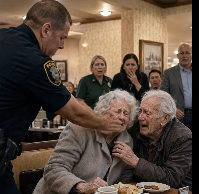
The restaurant was warm that evening.
Outside, the winter air moved through the streets of a small American town, cold enough to make people hurry from their cars to the front door. But inside the modest hotel restaurant, yellow lights glowed softly above wooden tables. Coffee cups clicked against saucers. Forks touched plates. A waitress moved between booths with a tired but kind smile. Families talked in low voices. A businessman read something on his phone near the window. An older couple near the counter shared a slice of pie.
It was an ordinary place.
Nothing fancy.
Nothing special.
But to Walter and Eleanor Miller, it felt like a gift.
Eleanor was ninety years old. Her curly white hair rested softly around her deeply wrinkled face. Her hands trembled even when she tried to keep them still. She wore an old beige coat with one missing button, carefully fastened at the top. Her eyes were gentle, tired, and full of a quiet sadness that came from living too long with too little.
Across from her sat her husband, Walter.
He was ninety-five, thin and bent, with white hair and a face shaped by hard work, weather, and years of worry. He wore a dark brown jacket that had been repaired at the sleeve. His wooden cane leaned against the booth beside him, close enough for his shaking hand to reach.
On their table sat two simple plates of food, one white coffee cup, a small brown handbag, and a folded napkin Walter had placed carefully beside Eleanor’s hand.
They were not loud.
They were not bothering anyone.
They were only eating.
Walter watched his wife lift a spoon with trembling fingers. She moved slowly, as if afraid to spill even a drop. He smiled at her, though his lips shook a little.
“Is it warm enough, Ellie?” he asked softly.
Eleanor looked up at him and gave a small smile.
“It’s perfect,” she said. “You always worry too much.”
Walter’s eyes softened.
“I’ve been worrying about you for sixty-six years,” he said. “No reason to stop now.”
For a moment, Eleanor almost laughed. It was not a big laugh, not the kind she used to have when they were young, but it was enough to make Walter’s heart feel lighter.
They had been married for more than sixty-five years.
Once, Walter had been a strong man who worked as a mechanic, coming home each night with grease on his hands and pain in his back. Eleanor had spent her life cooking, cleaning, raising children, stretching every dollar, and standing beside him through layoffs, sickness, hospital bills, and long winters when the heat had to be kept low to save money.
They had never been rich.
But they had been proud.
They paid what they owed. They helped neighbors when they could. They raised their children with love. They believed that if they worked hard and stayed kind, life would at least give them a peaceful ending.
But old age had not been gentle.
Their children had moved away. Phone calls became shorter. Visits became rare. Then visits stopped completely. Walter and Eleanor lived on a small fixed income that never seemed to last long enough. Some days, Eleanor ate toast and tea so Walter could have soup. Some days, Walter pretended he had eaten earlier so she would not worry.
That evening, Walter had counted the last bills in his pocket three times.
He knew they could not afford much.
But Eleanor had not eaten properly all day. Her hands had been colder than usual. Her face had looked pale. So Walter put on his old brown jacket, helped her into her beige coat, took his cane, and brought her to the restaurant connected to the small hotel near the bus station.
“Just one warm meal,” he had told her. “You deserve that much.”
Eleanor had said they should save the money.
Walter had shaken his head.
“A man should be able to buy his wife dinner once in a while.”
So they came in quietly. Walter paid at the counter first because he did not want anyone to think they were unable to pay. Then he helped Eleanor to the booth near the wall. He held her elbow as she sat. He placed her handbag beside her. He leaned his cane nearby.
For a little while, they felt normal.
Then the police officer entered.
At first, no one paid much attention. A uniformed officer walking into a diner was not unusual. But this officer did not come in calmly. He moved with sharp steps and an angry face, scanning the room until his eyes landed on Walter and Eleanor.
The restaurant manager stood behind the counter, nervous and unsure. A waitress froze beside a table, holding a coffee pot.
The officer walked straight toward the elderly couple.
Walter noticed him first.
His smile faded.
Eleanor looked at her husband’s face and whispered, “What is it?”
Walter reached across the table and touched her hand.
“It’s alright,” he said, though he was not sure.
The officer stopped beside their booth.
“You two need to leave,” he said.
His voice was loud enough for nearby diners to hear.
Eleanor blinked in confusion.
Walter looked up slowly. “Officer, we’re just eating.”
The officer’s jaw tightened.
“Don’t play games with me. Management doesn’t want people sitting here if they can’t pay.”
Walter’s hand shook.
“I already paid,” he said softly. “Before we sat down.”
The officer did not listen.
Eleanor looked frightened now, but she was still not crying. She folded her trembling hands in her lap and tried to make herself smaller.
“Sir,” she said gently, “we don’t want any trouble.”
The officer looked at her old coat, her shaking hands, the worn handbag, the cane near the booth.
His face filled with disgust.
“You people think you can just come in here and make the place look bad?” he said.
Walter’s eyes widened.
“Please,” he said. “Don’t speak to my wife like that.”
The restaurant grew quieter.
A young couple at the next table stopped eating. A man near the window lowered his phone. A mother pulled her child closer. The waitress took one step forward, then stopped, afraid.
The officer leaned closer to Eleanor.
“You don’t have the worth to sit here and eat,” he said.
The words cut through the room.
Eleanor’s face trembled, but still she did not cry. She only looked down at her plate, ashamed, as if poverty were something she had done wrong.
Walter gripped the edge of the table.
“Officer,” he said, his voice breaking, “we are old. We are hungry. We paid. Please just let us finish.”
The officer’s anger flashed.
Then it happened.
His hand moved quickly.
The slap struck Eleanor across the cheek.
It was not graphic. It was not dramatic like a movie fight. It was worse because it was real and cruel and sudden. Her head turned slightly from the force. Her spoon dropped onto the plate. The soft sound of metal against china echoed through the silent restaurant.
For one second, nobody moved.
Nobody breathed.
Eleanor slowly lifted her trembling fingers to her cheek.
Her eyes filled with tears.
Only then did she begin to cry.
Not loudly at first. Just a small broken sound from deep inside her chest, the sound of an old woman whose dignity had been shattered in front of strangers.
Walter reached for her in panic.
“Ellie,” he cried. “Oh God, Ellie.”
He tried to stand, but his weak legs shook under him. His hand searched for his cane and missed it. He nearly fell against the table.
“Please don’t hit her,” he begged the officer. “She’s my wife. Please. She’s my wife.”
His voice broke on the last word.
Wife.
That one word carried sixty-six years of love.
The first dance in a church basement.
The tiny apartment with no air conditioning.
The babies they held.
The bills they feared.
The hospital rooms.
The funerals.
The mornings when Eleanor made coffee before sunrise.
The nights when Walter came home too tired to speak, and she still waited for him with dinner.
That word carried their whole life.
And now he was saying it to a man who had just struck her.
Eleanor cried harder, but she still tried to calm Walter.
“I’m okay,” she whispered, though her cheek was red and her voice was shaking. “Walter, sit down. Please don’t fall.”
The diners watched in horror.
A woman covered her mouth. An older man looked down in shame. Someone whispered, “He hit her.” Another person reached for a phone but hesitated. The waitress’s eyes filled with tears.
Still, for a moment, no one helped.
That silence was its own kind of cruelty.
The officer stood there, breathing heavily, as if he had expected power to feel better than shame.
Walter finally found his cane and pulled himself upright. His body shook, but his eyes were fixed on Eleanor.
He took a napkin and gently touched the corner of her eye.
“I’m sorry,” he whispered.
Eleanor shook her head.
“You didn’t do it,” she said.
“I should have protected you.”
“You tried.”
Those two words broke him.
Because he had tried.
At ninety-five years old, with weak knees and a failing body, he had still tried to stand between his wife and humiliation. He had nothing left to fight with except love.
The manager finally rushed over from the counter, pale and shaking.
“Officer,” he said quickly, holding a receipt in his hand. “Wait. They paid. He paid before they sat down.”
The officer turned.
The manager held up the receipt. “They paid in cash. I remember now. The gentleman paid for both meals.”
The room changed.
Not loudly. Not suddenly.
But everyone felt it.
The truth had arrived too late.
The officer’s face tightened. His eyes moved from the receipt to Walter, then to Eleanor, who sat crying with one hand against her cheek.
For the first time, he looked unsure.
But shame after cruelty does not undo cruelty.
Walter looked at the manager, then at the officer, then at the silent restaurant.
His voice was weak, but every person heard him.
“We only wanted to eat in peace.”
Nobody answered.
What could they say?
The receipt proved they had paid for the food.
But who would pay for the humiliation?
Who would erase the sound of Eleanor’s spoon falling?
Who would erase Walter begging, “Please don’t hit her”?
Who would give back the dignity stolen from two elderly people who had done nothing wrong except look poor?
Walter slowly reached for Eleanor’s coat.
His fingers shook as he helped pull it around her shoulders.
“Come on, sweetheart,” he said softly. “We’ll eat somewhere kinder.”
Eleanor looked at him through tears.
“But your soup,” she whispered.
Walter gave her the saddest smile.
“I’m not hungry anymore.”
He helped her stand. It took time. His own knees trembled, and for a moment the waitress stepped forward as if she wanted to help. Walter nodded gratefully, but he kept one arm around his wife. He wanted to be the one to hold her.
Eleanor picked up her small brown handbag. Walter took his cane. The white coffee cup remained on the table, still half full. Their food sat untouched, growing cold under the warm restaurant lights.
As they passed the officer, he lowered his eyes.
“I…” he began.
But Walter did not stop.
Eleanor did.
She turned slightly, her cheek still marked by the slap, her eyes wet with tears.
“I wasn’t crying because you hit me,” she said softly.
The officer looked at her.
Eleanor reached for Walter’s hand.
“I cried because my husband still tried to protect me.”
Then she walked away with him.
The restaurant stayed silent as the old couple moved slowly toward the door. Walter held Eleanor’s hand with one hand and his cane with the other. Every step was painful. Every step was slow. But they walked together.
Outside, the cold dusk waited for them.
Walter opened the door and guided Eleanor through it carefully, the way he had guided her through life for more than six decades. The bell above the door gave a soft little ring as they left.
Behind them, the warm restaurant remained full of people who had seen everything and done nothing soon enough.
Their plates stayed on the table.
Their coffee cooled.
Their booth became empty.
But the shame stayed behind.
And as Walter and Eleanor disappeared into the cold evening, hand in hand, one truth remained in that room:
Poverty does not erase dignity.
Old age does not erase worth.
And no person becomes less human just because their coat is worn, their hands shake, or their pockets are nearly empty.